
In the Gospel of John, chapter 15, Jesus talks about needing to spend time “abiding” (or dwelling/living) with God. He uses the image of a vine and its branches – there’s no life if you get disconnected from the vine. Healthy branches are pruned so that they can bear more fruit, etc.
Earlier, in chapter 10, Jesus uses a different image of a shepherd and his sheep. The sheep know the Shepherd’s voice and only follow him. (I’ve seen this happen in Israel, not far from Bethlehem, it’s awesome to watch!)
In order to recognize the Shepherd’s voice, we need to spend time abiding with Him
• Where do you like to go to hear from God?
• What do you take with you?
• Do you prefer to be by yourself or with other people?
• How can you check that it is God and not just your own random thoughts?
Try this process that I find helpful:
1. Set aside some more time than you usually do to hear from God.
2. Ask God to speak to you as you read from his Word (the Bible).
3. Read a passage and the bits around it (for better context).
4. Read them again!
5. Write down anything that comes to mind as you read – thoughts, questions, ideas, pictures, songs, other scriptures, dreams, visions, words. Ask, “What is God trying to say to ME through this scripture?”
6. Pray for clarification.
7. Talk about what you’ve read with a trusted friend
8. Pray as God leads you for: change in your own life; other people whom God brings to your mind; the year ahead for the church
9. Write more stuff down so that you can remember what you were thinking about and bring it to church to discuss with others!
I Stand Near the Door
“We stand near the door.
We neither go too far in, nor stay too far out,
The door is the most important door in the world—
it is the door through which people walk when they find God.
There’s no use our going way inside, and staying there,
when so many are still outside, and they crave to know where the door is.
And all that so many ever find is only the wall where a door ought to be.
They creep along the wall like blind people with outstretched, groping hands.
Feeling for a door, knowing there must be a door,
Yet they never find it . . .
So we stay near the door.
“The most tremendous thing in the world
is for people to find that door—the door to God, to Jesus.
The most important thing our Missional Communities can do
is to take hold of one of those blind, groping hands,
and put it on the latch—the latch that only clicks
and opens to the person’s own touch.
People die outside that door, as starving beggars die on cold nights in cruel cities in the dead of winter—
Die for want of what is within their grasp.
Nothing else matters compared to helping people find it,
and opening it, and walking in, and finding Him . . .
So we stand near the door.
The people on the other side of it, live—live because they have found the door.
We admire the people who must inhabit those inner rooms, and know the depths and heights of God, and call outside to the rest of us how wonderful it is. Even sometimes we take a deeper look in, sometimes venture a little farther;
but our place seems closer to the opening, not forgetting those outside… so we are building a home near the door.
Near enough to God to hear Him, and know He is there,
but not so far from the people in our community as not to hear them,
For remember, they are there too.
Where? Outside the door—
hundreds of them, thousands of them.
But—more important for us—
One of them, two of them, ten of them,
Whose hands we are intended to put on the latch,
So we shall stay by the door and wait for the opportunity.
So we stand near the door.”
“So I Stand Near the Door” by Reverend Samuel Moor Shoemaker. (Adapted for St Matt’s Op-Shop Missional Community by Chris Crook, October 2015.)
Imagine a church of fiery-hearted disciples . .
One of my life-goals is: Be led more by Jesus, lead more like Jesus, lead more to Jesus. More recently, I have framed my own discipleship in terms of Passionate Spirituality, Radical Community and Missionary Zeal.
Jesus made disciples by inviting them to “do life” with him. To learn from him as he went about life and ministry, observing & reflecting what God was doing and then putting into practise the things he had taught them, all within a relationship which allowed for honest review & critique amidst healthy support and encouragement.
No one leader can manage all that for each person. But that’s not how Jesus did it either. He had his few, his twelve, his 72 and his crowd. The way I’ve been doing it recently is to Huddle (coach/mentor) leaders, to help them create Missional Communities of 20-30 people and to Celebrate when we all gather together, what God has been doing and is going to do amongst us.
My goal is to establish a similar discipling culture in which, ultimately, over time, each person would have the opportunity to grow in all three dimensions of their faith, “doing life” with a living example of someone who follows Jesus and themselves becoming such an example to others. As Paul says in 1 Cor 11:1, “Follow my example, as I follow the example of Christ.”
Passionate Spirituality – will look like honest and open engagement with the Word in private, in small groups, in gathered worship and in public. It will sound like heart-felt worship, formally and informally, as church and as individuals. It will feel like the Spirit testifying to our spirits that we are children of God, experiencing both the intimacy of the Father and the awesomeness of our Creator. It will issue forth in empty-handed and fully-dependant prayer.
Radical Community – will challenge us to dethrone individualism and exclusive tribalism in favour of accountability, welcome and belonging to one another. It will lead us to open our lives to those we are less comfortable with and express grace and forgiveness to those who’ve hurt us. It will give opportunity to explore gifts and exercise talents amongst accepting hearts and minds. It will provide wide-spread care and pastoring across and beyond the edges of our congregations.
Missionary Zeal – will lead us to the margins and the common spaces with Jesus on our lips and Good News in our actions. We will serve until it hurts and cry out until they come. We will seek out the last, the least and the lost. We will give generously and love outrageously. We will go and make disciples, who make disciples . . .
#fieryhearts
A long obedience in the same direction . . . ten years on
I think it was Eugene Peterson who first described discipleship as “A long obedience in the same direction”.
Now, by nature, passion and God’s giftings I have mostly considered myself to be a pioneer-type (as distinct from a settler-type). That means I’m more concerned with winning ground than keeping it. And my Five-fold ministry-type from Ephesians 4 usually comes out as Apostle/Evangelist, which again positions me as a starter-up person rather than a long-grind hanger-on person. (These are highly technical terms you understand!)
In this great article by Hugh Halter: http://hughhalter.com/blog/2015/03/15/one-reason-missional-will-or-wont-work-for-you his basic thesis is that you have to stick to the call and learn to live it out for the rest of your life in authentically contextualised ways.
Recently I met with one of my “heroes”, Peter Crawford, who was just retiring after 35 years at his church in Emerald, Victoria. His encouragement to me was to see ourselves at St Matt’s as “still in transition”!
But actually this resonates with a somewhat prophetic word I had not long after arriving at St Matt’s when I was asked how long I would be there. I replied that we would need a 10-25 year “rebuilding” program if we were going to transition our church from “attractional” (they come to us), to “missional” (we go to them).
And in a further “word” a couple of years ago, God seemed to be affirming that it would take 7 years of clearing away and rebuilding foundations, 7 years of consolidation with some small amount of fruit and then 7 years of good, healthy growth. We’re about half-way through.
I don’t know if it’ll be me that sees the project through the whole 21-25 years and beyond. I would say though that we are on track and it will take all that time to firmly bed-down this missional model of church expressed at St Matt’s East Geelong.
If you want to join us or come and see what we’re up to, feel free to make contact.
Making Disciples
Joseph Pilon reaffirmed his baptism last week. (I first met Joseph when he became friends with our son Jack. He became part of one of our first Missional Communities: X-Pod). He gave his testimony to how God had changed his life and then we got busy with the water!
Water, to most people, obviously represents life. Here in Australia, a land of regular droughts, we know how vital it is and how desperate we can become to have it.
But we also know how having too much of it can cost your life.
There’s a mixture of metaphors in the water of Baptism but we think of them as all coming together in Jesus. He said to a woman he met at a well once, (in John 4:13-14) “Everyone who drinks this water will be thirsty again, (14) but those who drink the water I give them will never thirst. Indeed, the water I give them will become in them a spring of water welling up to eternal life.”
He was talking about the Holy Spirit (which is the very “essence” of God). Imagine that – Jesus giving us something amazing of God to live within us. Blows my mind every time I think about it.
But it requires something of the second metaphor. Baptism in the original Greek language, means to be overwhelmed to the point of death. (They used to say a ship that had sunk had been baptized!)
And Jesus said, (in Mark 8:34) “Whoever wants to be my disciple must deny themselves and take up their cross and follow me”.
Denying and dying . . .
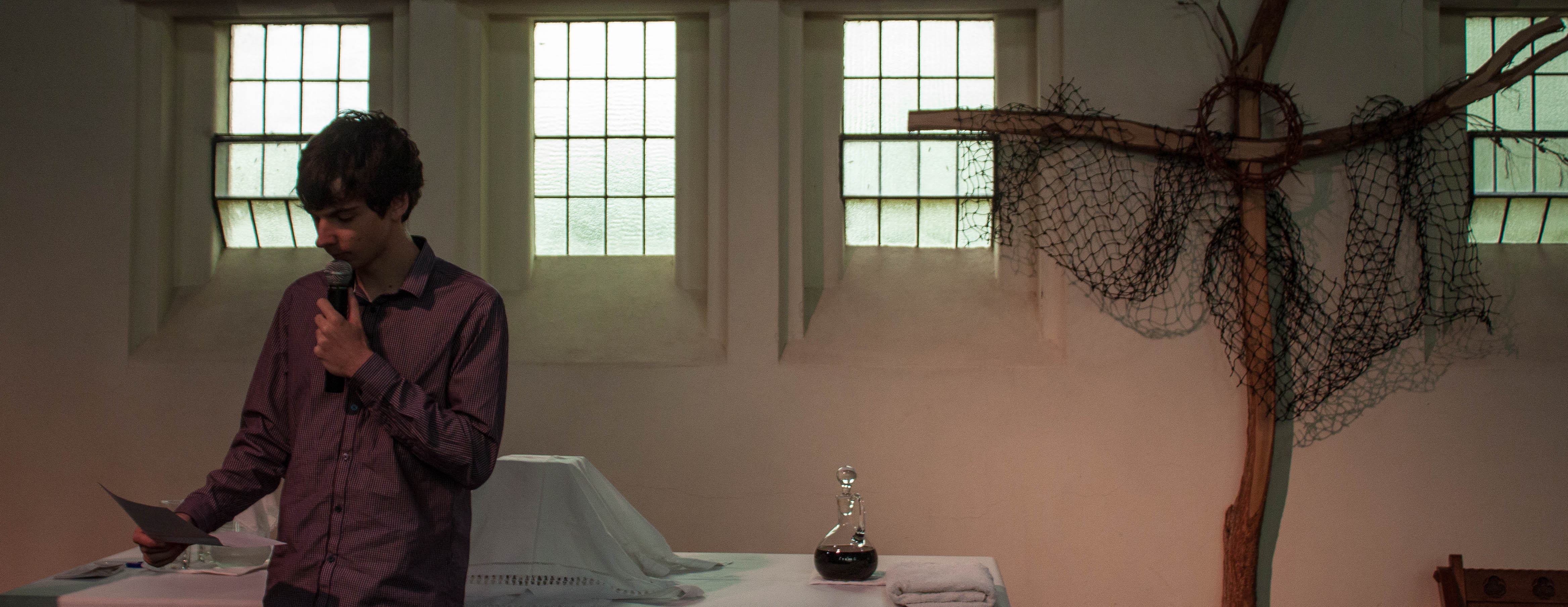
Jesus commissioned his first disciples (in Matthew 28:19-20), to “go and make disciples of all nations, baptizing them in the name of the Father and of the Son and of the Holy Spirit, (20) and teaching them to obey everything I have commanded you. And surely I am with you always, to the very end of the age.”
Joseph joins a long, long line of disciples who have been called to make more disciples – we better pray for him!
Photos used by kind permission of Fabrice Pilon – Joseph’s father.
Wanting big tomatoes . . . (or, on being strategic)
This is my friend Chris Crook’s 500g+ tomato – what a beauty!

At our church we have a monthly meeting of all our Missional Community leaders, (BTW, I also love this Walmart/Coke ad which kind of describes what we are trying to create – extended family) . The typical format of our meeting is:
- Trenches (30 mins) – the highs and lows (boo’s & cheer’s youth workers call this – depraved Anglican adults call this booze and cheese . . . ) of what each community has been up to
- Training (30 mins) – maybe a bible study, or some other key point I want to communicate and discuss with our leaders
- Prayer (30 mins) – praying about the things raised in either Trenches or Training, or any other matter we also need God’s help with.
Chris was saying that the way he got such a big tomato was by trimming the stem so that all the goodness was channeled into the one with this fruit on it. As he thought about how clever that was, he was also thinking that perhaps God was speaking to him about how to be strategic with his time, energy and resources.
While we were discussing this Jeanenne thought God gave her a scripture which backed up what Chris was saying. This is found in Luke 9:62, where Jesus says, “No one who puts a hand to the plow and looks back is fit for service in the kingdom of God.” [NB. I like to put words of scripture in italics to signify they are different and special]
Anyway, this is how this metaphor was described to me once. You have to imagine a farmer with a hand-plow. So there’s a farmer, with both hands on the plow, guiding it into the ground. Ahead of him is an ox or a donkey which he is attached to by a pair of reins. Something like this dude here:
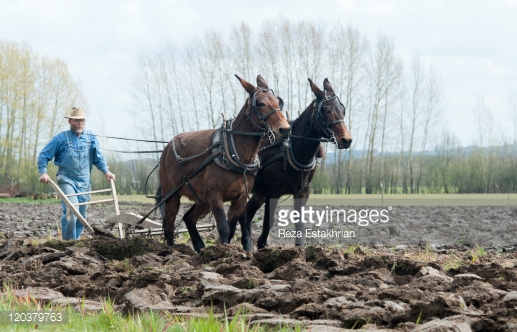
But his hands have to stay on the plow-handles so he steers by having the reins wrapped round his shoulders. So if he wants to stay in a straight line, he has to keep his shoulders straight ahead. If he wants to turn, he turns his shoulders and the animal turns accordingly – you see?
So what Jesus is saying, is that once you set your hand to the plow (of doing kingdom ministry), it’s no good turning back because if you turn you go all over the shop! Or in other words, “Stay focused on what you believe God has called you to do – don’t let yourself get distracted”.
And Chris’s application of this is that if you do channel your efforts strategically, you will bear big fruit. (see also Jesus talking about the vine and the branches in John 15).
This is just one of the gems we get when we gather and try to listen to what God might be saying. Can you see how we like to check what we think with what we believe God has said in the Bible? What do you do to listen to God? Are you better on your own or with a group of people?
And as far as growing big tomatoes goes – what do you need to trim from your busy life in order to be more strategic with your efforts for God’s work in the world?
Introducing Cascade . . .
Lake Galilee (first photo below) – it’s nearly three years since I visited there with a study tour led by my friend, Bob Rognlien and daily bible studies led by Mike Breen. (We’re all in The Order of Mission [T.O.M.] together, as were many of the folk on that tour – but I also got to take my Dad and another good friend Tim).
When we were there it was like a mill pond, as you can see. You can just about see Syria on the horizon, only something like 7.5 miles away! (The Sea of Galilee is about 8 miles wide and 13 long, or approx 13 x 21 km).
Some of the most amazing stories from the life of Jesus happened around this lake (or sea). Jesus walking on the water is probably the most famous. A friend of mine (Aled Griffith) recently noted the account of this in (Mark 6:47-51) . . .
“When evening came, the boat was in the middle of the lake, and he was alone on land. (48) He saw the disciples straining at the oars, because the wind was against them. Shortly before dawn he went out to them, walking on the lake. He was about to pass by them, (49) but when they saw him walking on the lake, they thought he was a ghost. They cried out, (50) because they all saw him and were terrified. Immediately he spoke to them and said, “Take courage! It is I. Don’t be afraid.” (51) Then he climbed into the boat with them, and the wind died down. They were completely amazed”
. . . Aled noticed that the disciples were straining at their task of rowing and Jesus was about to pass them by. Then they were terrified because they thought he was a ghost. [How else can someone walk on water?] But then Jesus gets in the boat with them and the wind dies down.
Aled reckons, and I agree, that it’s important to invite Jesus “into the boat” as it were. We can strain against all the things which are making the journey hard, but when Jesus gets in with us, everything changes.
This blog is about recognizing all that God has for us and receiving that by journeying with and learning from Jesus. And then passing it onto others. Jesus said to his disciples, (Matthew 10:7-8)
“As you go, proclaim this message: ‘The kingdom of heaven has come near.’ (8) Heal the sick, raise the dead, cleanse those who have leprosy, drive out demons. Freely you have received, freely give.”
One of the things I love most is putting the bible and ministry into the hands of ordinary people. The waterfall at Banias (second photo below) reminds me of the way God “feeds us” from above, we get nourished and then pass on what we have learned. So, Cascade Ministries, is really just me passing on what I’m working out about God to anyone who might be interested in joining me as I try to follow Jesus.
If you have any questions, feel free to post a comment . . .


 Cascade Ministries